
Passenger vehicle wholesales in India declined by 10 per cent to 2,61,633 units last month as compared to March this year, as COVID-19-led restrictions across various states impacted demand, auto industry body SIAM said on Wednesday. Passenger vehicle sales in March 2021, stood at 290,939 units.

Passenger vehicle wholesales in India increased by 17 per cent in the second quarter of the current fiscal year as buying sentiment improved and companies stocked up to cater to enhanced demand in the festive season, auto industry body SIAM said on Friday. According to the latest data by the Society of Indian Automobile Manufacturers (SIAM), passenger vehicles sales in the July-September quarter increased to 726,232 units from 620,620 units in the same period last year. Similarly, two-wheeler sales during the September quarter this fiscal rose marginally to 46,90,565 units as compared with 46,82,571 units in the same period last fiscal. However, commercial vehicles sales saw a dip of 20.13 per cent at 133,524 units in the quarter under review as compared with 167,173 units in July-September 2019.

During April, Maruti Suzuki India's domestic car sales were up 2.72 per cent at 86,481 units, as against 84,188 units in the same month last year.

Maruti Ciaz and Ertiga are exempt from the infrastructure cess and so, there is no change in the prices of these models.

During May, Maruti Suzuki's domestic car sales were up 2.59 per cent at 87,402 units as against 85,190 units in the same month last year.

Passenger vehicle wholesales in India rose by 14.16 per cent in August to 2,15,916 units, driven by pent-up demand, industry body SIAM said on Friday. According to the latest data by the Society of Indian Automobile Manufacturers, passenger vehicle wholesales stood at 1,89,129 units in the same month last year.

While the overall passenger car industry is expected to grow at around seven per cent a year in the next five years, SUV growth is expected to be over 10 per cent.

There was no sale of premium sedan Kizashi during the month.

Market leader Maruti Suzuki sold 51,274 units, down 49.61 per cent from the same month last year. Hyundai Motor sold 21,320 units, a decline of 49.25 per cent and Mahindra & Mahindra sold 8,075 units, down 54.54 per cent.

The auto industry has had a mixed month. The build up to Dhanteras and Diwali was good but the demand tapered off subsequently.

Let alone a discount, they might not even get the model, variant or colour of choice in BS-IV-compliant vehicles.

Nissan and Renault say they will compete with new models, especially small cars, and by growing their dealer network.

Tata Motors on Friday said it will hike the prices of its passenger vehicles, excluding the Nano, by up to Rs 36,000 from April 1, to offset rising input costs.

The economy segment of India's car market is unlikely to revive soon term as inflation and prices prompt buyers to defer purchases. The share of entry-level cars in the passenger vehicle market dropped to the lowest in seven years at the end of the Financial Year 2021-22 (FY22). A recovery in the segment will be largely driven by the overall economic growth, improvement in income levels, and easing of semiconductor shortage, say carmakers and analysts.

Car sales are experiencing a challenging phase with around Rs 60,000 crore worth of inventory lying unsold with dealers.

Ahead of the international auto show that begins next Wednesday, the Indian auto industry continues to be buffeted with bad news. According to data released by leading automobile companies on Saturday, the industry's sales volumes in January fell about five per cent from those in the same month last year.
'It says, we are not just an overseas player -- we are Kia India and here for good'

White is easy to maintain, looks brighter than other colours over a longer period, is the least commonly rejected colour among family members, has high resale value, provides better safety at night, absorbs less heat in the summer season, makes small cars look bigger, and is not considered inauspicious.

The increase in PV sales in September was driven by festive season purchases, with SUV models like Maruti Suzuki's Brezza, Hyundai Creta, Mahindra Scorpio, Ford Ecosport and Honda W-RV witnessing good traction

It plans to increase India sales by a tenth, helped largely by launches next year

The dealers operating in the space have jumped nearly three times over the past two years.

Companies have also managed to find talent created by frequent exits.

Sales of diesel-powered utility vehicles have been declining in the past six months as the differential between petrol and diesel prices narrowed.

As per SIAM data, vehicle sales across categories, including passenger vehicles and two-wheelers and commercial vehicles stood at 18,21,490 units last month as against 23,82,436 units in August 2018, a fall of 23.55 per cent.

India is a market for low-priced cars with low running costs. The global majors don't have models that fit the bill; only Maruti and Hyundai have successful entry-level models, observes T N Ninan.

Seven auto companies lost share in the current year because of different reasons.

The models from Hyundai and Maruti, which might go on sale in October 2018 and February 2019, respectively, are set to revive a segment that had lost sheen to the compact SUV segment, lately

The EV industry is at an inflection point and batteries will play a critical role ahead -- batteries and related components typically constitute 35-45 per cent of an EV's costs.

The price differential has been upwards of 20%.

Despite a rise in input costs, leading car-makers refrain from hiking their price.

Cumulative sale at India's top six passenger vehicle (PV) makers dropped 0.7 per cent to 267,000 units, from 269,000 a year before.
.jpg)
The compact segment makes up for nearly 25 per cent of car sales in India.

Ford said it had also shut its plant, with an annual capacity of 340,000 engines and 200,000 vehicles.

The facelifted Elantra is a loaded with features and will give it tough to rivals.

Demand for passenger vehicles has been driven by new models, especially in the SUV category with the likes of Maruti Vitara Brezza and Hyundai Creta clocking good numbers

The industry needs stimuli to help revive consumer demand and conversions.
Vehicle prices have gone up as manufacturers gear up for the transition to stricter emission norm BS-VI from BS-IV beginning April 1.

The diesel variant has an average of 24kmpl while the petrol delivers 18.9 kmpl.

Almost all of these companies either unveiled their new electric vehicle or alternative energy-powered models.
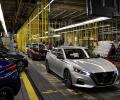
Pandemic-hit auto majors are likely to set aside these time-tested strategies for now, and, instead, focus on attractive finance schemes and an enhanced digital experience.
